A park information sign tells visitors where they are, what the park offers and which rules apply. Most parks need several kinds: an entrance sign, a main kiosk, rules signs, facility signs and the occasional temporary notice. A visitor decides in a few seconds whether a sign is worth reading. People read the signs that look official and current, and they walk past the rest.
This guide covers how to design the full set of information signs across a park or park system. It explains which sign types to include, what each one should say, how to give them one consistent look, and how to size, mount and update them. Pannier Graphics manufactures park signs and the frames that hold them in-house. The examples below come from parks where Pannier built the signs.
In Short
Most parks use five kinds of information signs: entrance signs, a main kiosk, rules signs, facility signs and temporary notices. Each type should answer one question for the visitor. Signs that share the same colors, typeface, logo placement and frame style read as official information from a distance. Size each sign for how people approach it, and use replaceable panels so an update doesn't require a new structure.
Know Which Signs Make Up a Park's Information System
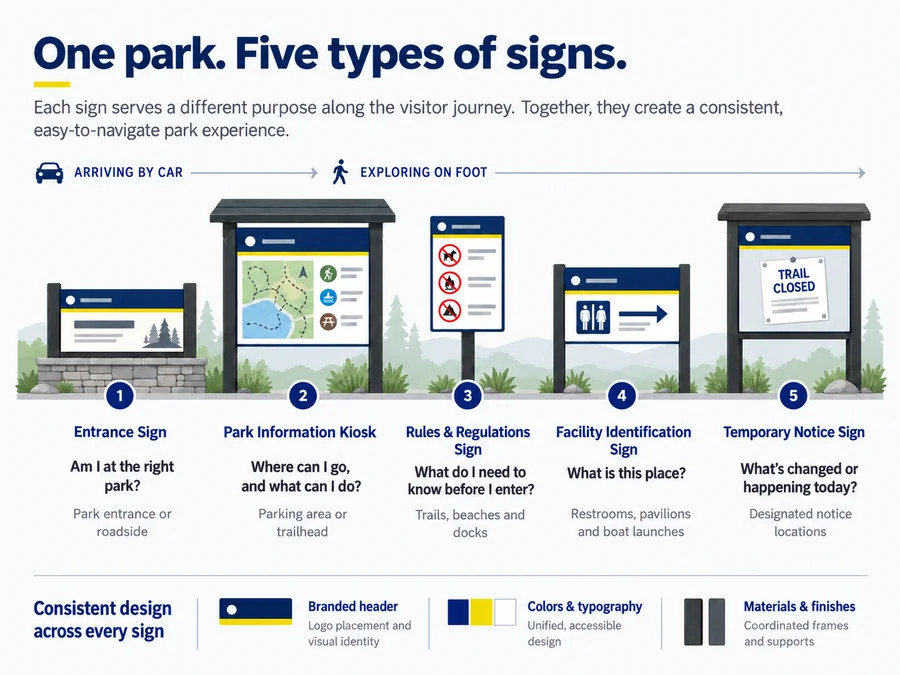
A park's information signs fall into five types, and visitors meet them in roughly the same order. The entrance sign comes first, and most people read it from a car. The main information kiosk stands near the parking lot or trailhead, where people stop and plan their visit. Rules signs stand where specific activities happen. Facility signs name buildings and amenities such as restrooms, pavilions and boat launches. Temporary notices cover closures, events and seasonal changes.
Large park agencies write this structure into their sign manuals. The Ohio Department of Natural Resources park sign manual sorts its park signs into 10 categories. The Philadelphia Parks & Recreation signage standards group signs by job, including identification, rules and regulations, bulletin boards and temporary signs. A township park with one pond and a playground can use the same five types at a smaller scale.
This guide covers the signs that identify, inform and regulate. Directional signs that move people from place to place belong to a park's wayfinding system, which our guide to wayfinding signage design covers. Panels that tell a site's natural or cultural story follow the approach in Interpretive Signage That Gets Read.
Shopping for Park Signs?
Pannier builds entrance signs, kiosks and rules panels for local, state and national parks, with the frames and bases made in the same shop.
Give Each Sign Type One Job
Each park information sign works best when it answers one question for the visitor. Visitors skim a sign that welcomes them, lists 20 rules and announces a festival, and they miss the line that mattered. Assign each type its question before anyone writes copy:
- Entrance sign: Am I in the right place? Give the park's name, the agency that manages it and the hours. Searches for park entrance signs mostly turn up monument-style signs, large permanent structures built to be read from a car. Keep the text to a few words so drivers can read it at speed.
- Main kiosk: What's here, and how do I use it? Show the whole-park map, the rules that apply everywhere, the hours and an emergency contact. Our guide to outdoor information board design covers how to lay out the board itself.
- Rules sign: What's allowed at this spot? List only the rules for that location, such as leash rules at a trail or swimming rules at a beach.
- Facility sign: What is this building or area? Give the name and one or two facts a visitor needs on arrival, such as hours or accessible entrances.
- Temporary notice: What's different today? Post closures, events and seasonal hours in one dedicated spot so visitors know where to look.
Check every line of copy against its sign's question. A rule that applies across the park goes on the kiosk. A rule that applies at the pond goes at the pond.
Make Every Sign Look Like It Belongs to the Same Park
Park information signs that share one look let visitors spot official information from across a parking lot. Once a visitor learns what the park's rules sign looks like, they recognize the next one without reading a word.
Set the Shared Design Elements
Choose these elements once and apply them to every sign in the set:
- Color by sign type. Philadelphia Parks & Recreation uses navy for identification signs, light blue for rules and regulations and gray for closures.
- One typeface family, with set sizes for headings and body text.
- The park or agency logo in the same position on every panel.
- One panel material, so colors and finish match from sign to sign.
- Matching frames and bases, in one style and one finish color.
Chester's Veterans Memorial Park in Chester, Pennsylvania, uses a matched set. Across the 20-acre park, Pannier produced Fiberglass Embedded panels on single and double pedestal bases. Every sign in the park uses the same panel material and base style.
Write It Down in a Sign Standard
A one-page sign standard keeps signs ordered years apart looking the same. List the exact color codes, the typeface and sizes, the logo placement, the panel material, the base style and the frame finish. Send it with every order. Parks departments that add signs as budgets allow need this most, because the person ordering signs three years from now may not be the person ordering them today.
Put Park Rules Where People Will Read Them
Visitors follow park rules signage when each sign is short and stands where the rule applies. A list of 25 rules at the entrance gets a glance. The person about to cast a line reads a two-line sign at the dock.
- Post each rule at the point of use. Put leash rules at the trailhead, swimming rules at the beach and fishing rules at the dock.
- Keep the kiosk to park-wide rules. Hours, pets, alcohol and anything else that applies everywhere belong on the main board.
- Limit each rules sign to a few lines. The Ohio DNR manual tells sign designers to keep text brief and to use visuals over text when possible. A symbol for no swimming reads faster than a sentence.
- Give hazard warnings a separate look. A warning about a steep drop or thin ice needs to stand apart from house rules. Ohio DNR uses white signs with black lettering for regulations and yellow signs with black lettering for caution. Confirm which color conventions your agency or jurisdiction follows.
- Give the reason when it helps. A line like “Keep dogs leashed to protect nesting birds” tells visitors why the rule exists.
Size and Mount Each Sign for How Visitors Approach It
A sign read from a moving car needs a larger panel and taller letters than a sign read by someone standing on a path. Plan each sign's size, letter height and mounting around how visitors reach it.
Entrance signs serve drivers. Ohio DNR's primary park entrance signs measure 4 by 8 feet or 4 by 10 feet, and they stand back from the road where drivers can read them at speed. A kiosk or rules sign serves people on foot, and it can use a smaller panel with smaller text. Use the letter height visibility chart to match letter size to the distance people will read from.
The Bureau of Reclamation sign guidelines suggest mounting signs for foot traffic about 4 feet high, measured from the ground to the sign's lower edge. Low-profile bases angle a panel for people who stop at a rail or overlook to read. Uprights and kiosks hold panels at eye level for people walking up to them. The base options page shows how each base sets into the ground.
Plan the fewest signs that cover what visitors need. The Bureau of Reclamation guide states that “too many signs reduce effectiveness.” Each extra sign competes with the ones that matter.
The park or its planning firm decides where each sign stands. Pannier builds every sign to that spec and supplies the hardware that attaches the panel to its post or frame. Park crews or contractors handle the installation.
Keep the Information Current Without Replacing the Sign
A park information sign with last year's hours or a closed trail on its map makes visitors doubt every other sign in the park. Plan for updates while you design the set:
- Separate permanent and changeable content. The park name, map and park-wide rules rarely change. Hours, events and seasonal closures change often, and they belong in a changeable area such as a bulletin case.
- Use replaceable panels. Pannier's park signs use modular designs, so a new panel goes into the existing frame. A rule change means one new panel and no new structure.
- Keep a sign inventory. The Bureau of Reclamation guide recommends recording each sign's location, dimensions, material, installation date and last maintenance date.
- Inspect every sign once a year. Ohio DNR inspects every park sign each January or February and cleans or replaces vandalized signs right away.
Hampton Township in Allison Park, Pennsylvania, runs its StoryWalk this way. Pannier built 20 StoryWalk exhibits with backer panels, and township staff swap in a new story each season while the frames stay in place. The same setup works for a park's seasonal hours or event notices.
Clean signs on a schedule too. The sign maintenance guide covers how to clean outdoor panels without damaging them.
Build the Whole Sign Family With One Manufacturer
A park gets a matched set of information signs when one manufacturer builds the panels and the frames to the same specs on every order. Colors, materials and base styles drift when each new sign comes from a different shop.
Pannier Graphics is a family-owned manufacturer based in Pennsylvania. Pannier designs, fabricates and finishes sign panels and the frames and bases that hold them in its own facility. It is not a reseller. A rules sign ordered next spring comes off the same line as this year's kiosk, in the same color, material and base style.
Fiberglass Embedded panels seal the graphics beneath the surface, where they resist UV fading and graffiti, and they carry a 10-plus year lifespan outdoors. Gel Coat Laminate panels are another option for parks with different budget or display needs.
Erie MetroParks used one manufacturer for its entire Discovery Trail sign set. At Osborn MetroPark in Erie County, Ohio, Pannier fabricated 48 cut-to-shape Fiberglass Embedded panels: 14 educational panels, 3 entrance panels and 31 arrow-shaped trail panels. Every panel shares one material and one standard, from the entrance to the end of the trail.
Most parks supply their own artwork, and Pannier's design team can help when a park needs it. Panels typically ship in about four weeks and frames in about six. The park decides what signs it needs and where they go. Pannier builds them to that spec and delivers them ready to mount.
Key Takeaways
- Most parks use five types of information signs: entrance signs, a main kiosk, rules signs, facility signs and temporary notices.
- Give each sign type one question to answer, and keep its copy to that question.
- Use the same colors, typeface, logo placement, panel material and base style on every sign, and write them into a one-page sign standard.
- Post each rule where the activity happens, and keep the kiosk to rules that apply park-wide.
- Size and mount each sign for how visitors reach it: large panels for drivers, eye-level or angled panels for people on foot.
- Use replaceable panels, keep a sign inventory and inspect every sign once a year.
Frequently Asked Questions
What is a park information sign?
A park information sign is any sign that tells visitors where they are, what the park offers or which rules apply. The main types are entrance signs, information kiosks, rules signs, facility signs and temporary notices. Directional and interpretive signs are separate families with their own design standards.
What should a park entrance sign include?
A park entrance sign should include the park's name, the agency that manages it and the hours. Keep the text short enough for drivers to read at speed. Save maps and rules for the main kiosk inside the park.
What should be on a park rules sign?
A park rules sign should list only the rules that apply at that spot, in a few short lines. Use symbols where they work, and give the reason for a rule when it helps people follow it. Park-wide rules belong on the main kiosk.
How high should park signs be mounted?
Park signs for pedestrians should be mounted with the lower edge about 4 feet above the ground, the height the Bureau of Reclamation's sign guidelines suggest for foot traffic. Low-profile bases angle the panel lower for people who stop to read. Entrance signs for drivers use larger panels, placed for reading from a car.
How many signs does a park need?
A park needs the fewest signs that answer visitors' questions: usually one entrance sign per entrance, one main kiosk, a rules sign at each activity area and a sign for each major facility. The Bureau of Reclamation's guidelines warn that too many signs reduce effectiveness. Cut any sign that repeats another.
Final Thoughts
Visitors read park information signs that look official, answer one question and stay current. Pannier Graphics designs and manufactures park signs, panels and the frames that hold them in-house, from design through delivery. Pannier builds every order to the same standard, so next year's rules sign matches this year's kiosk. Tell us about your park and the signs it needs.


