Historical marker signs are a public promise that a story will outlive the people who paid for it. A committee, a family, or a grant funds the marker once, and then the community expects it to stand and stay true for 30 or 40 years. That promise breaks in two ways. The sign itself can fade, crack, get tagged with graffiti, or get pried off its base for scrap. The story can fail more quietly, when a date turns out wrong and cannot be corrected, or when wording that sounded fine at the dedication reads as dated a generation later. Protecting a story for decades means treating both problems as design problems, and solving them before anyone approves a layout.
In Short
A historical marker sign has two things to protect: the physical marker and the story on it. The marker faces weather, UV, and vandalism, and the story faces bad research and wording that ages badly. This guide covers how to get the history right before you design anything, how to write content that still reads well in 30 years, which materials survive outdoors and resist vandals, and how to mount and maintain a marker so it lasts for the long haul.
Know What a Historical Marker Sign Has to Survive
A historical marker faces two kinds of failure over its life, and good design plans for both from the start. The physical failures are the obvious ones: ultraviolet light fades unprotected graphics, freeze and thaw cycles work at seams and fasteners, moisture finds any gap, graffiti lands on flat surfaces, and cast metal markers get stolen for scrap. The editorial failures are quieter and harder to fix. A wrong date, a misspelled name, or a fact that later research overturns becomes permanent the moment the panel is manufactured. So does wording that frames the history in a way that reads as incomplete or one-sided decades on.
What makes historical marker signs different from most signage is the time horizon. A menu board or a sale sign is built to be replaced. A historical marker is built for a reader who has not been born yet. That single constraint should drive every decision that follows, from how carefully you check a source to which material you choose and how you fasten it to the ground. Plan against both failure modes at once and the marker does its job for generations. Ignore either one and the story either disappears or turns into a mistake set in fiberglass.
Ready to Build a Marker That Lasts?
Pannier manufactures historical markers and interpretive panels in-house, in materials built to carry a story outdoors for decades.
Get the History Right Before You Design Anything
The most expensive mistake on a historical marker is a factual one, because you cannot quietly edit a panel once it is made and installed. A typo on a website is a five-minute fix. The same typo cast or embedded into a marker means a reprint, a reinstall, and an awkward conversation with whoever funded the first one. So the research has to be finished, checked, and settled before design starts, not alongside it.
Treat the text as a claim that will be read closely and challenged. A short verification routine keeps you honest:
- Work from primary sources. Deeds, census records, letters, newspapers of the period, and original photographs carry more weight than a secondary summary that may have repeated an error.
- Partner with people who hold the records. A local historical society, a county archive, or a university special collection can confirm a detail in an afternoon that would take you a week to chase down.
- Verify every name, date, and spelling against more than one source. A single source is a lead, not a fact.
- Have the text reviewed by a subject-matter expert, and by the community the story is about. The people closest to a history often catch the framing problems an outside writer misses.
Official marker programs set this bar deliberately, and their standards are a useful model even for a marker you fund privately. Pennsylvania's official program, run by the Pennsylvania Historical and Museum Commission, requires each nomination to cite at least one primary or secondary source for every point it makes, with a minimum of three to four sources total and at least one of them primary. Nominations are then read independently by a committee of commission staff and by a separate panel of five outside experts in history and related fields before the commission votes. That is the level of scrutiny a public historical claim invites, so it is the level your text should be ready for.
Holly's Hill Park in Souderton, Pennsylvania shows what that care looks like on a single marker. Pannier produced one fiberglass embedded interpretive panel, mounted on a double-sided upright base, to tell the story of the Holly family, who introduced hand cheese to the region in the 1870s and moved the business to Souderton in 1892. The family chose an Old English typeface drawn from the original cheese-wrapper labels and a green background to sit with the park. Twenty-two descendants raised the money and gave what was left over to the Souderton-Telford Historical Society. The specifics carried the marker, and the specifics came from people who knew the history firsthand.
Write the Story So It Still Reads Well in 30 Years
Content lasts when it avoids the words and choices that quietly date a sign. A marker written today will be read for decades, so the writing has to earn that lifespan. Three habits do most of the work.
Cut Anything That Will Be Wrong Later
Relative time is the biggest offender. Words like "recently," "today," "current," "modern," and "now" are true only at the dedication and start decaying the next day. Write in fixed terms instead. A few common swaps make the point:
- "recently restored" becomes "restored in 2024"
- "the current owner" becomes "the owner as of 2026" or just the owner's name
- "modern visitors" becomes "visitors" or a dated reference
- "state-of-the-art at the time" becomes the actual year and detail
The same discipline applies to anything tied to a living institution or a temporary condition. A company name, a building's use, or a nearby road can all change, so anchor the sentence to the history rather than to something that will move.
Tell One Story Well Instead of the Whole History
A marker is not a book. The interpretive field often describes reader attention as a "3-30-3" pattern: roughly 3 seconds to catch someone walking past, about 30 seconds to land your main point if they stop, and around 3 minutes for the rare visitor who reads every word. A panel that tries to cover a century in dense paragraphs loses the first two readers, who are almost everyone. Pick the one idea that matters most, lead with it, and let the rest go or move to a second panel.
Write Plainly and Frame It Honestly
Short, active sentences read faster and age better than formal, clause-heavy ones. Name the people who acted and let them act, rather than hiding them behind passive constructions that blur who did what. Just as important, tell the story completely enough that it does not read as one-sided later. Histories that leave out the hard parts tend to look evasive to the next generation, and a marker that has to be quietly retired is the opposite of a story protected for decades. When there is genuinely more to say than one panel can hold, add a second panel rather than shrinking the type, since a marker nobody can read protects nothing. For the deeper mechanics of writing and laying out an interpretive panel, our guide to interpretive signage that gets read goes further than there is room for here.
Choose a Material That Outlasts the Weather and the Vandals
Material is one of the biggest factors in whether a historical marker is still legible years from now or has become faded, damaged, or difficult to read. For a marker meant to preserve a story, durability is not just about the panel surviving outdoors. The graphics themselves have to remain protected.
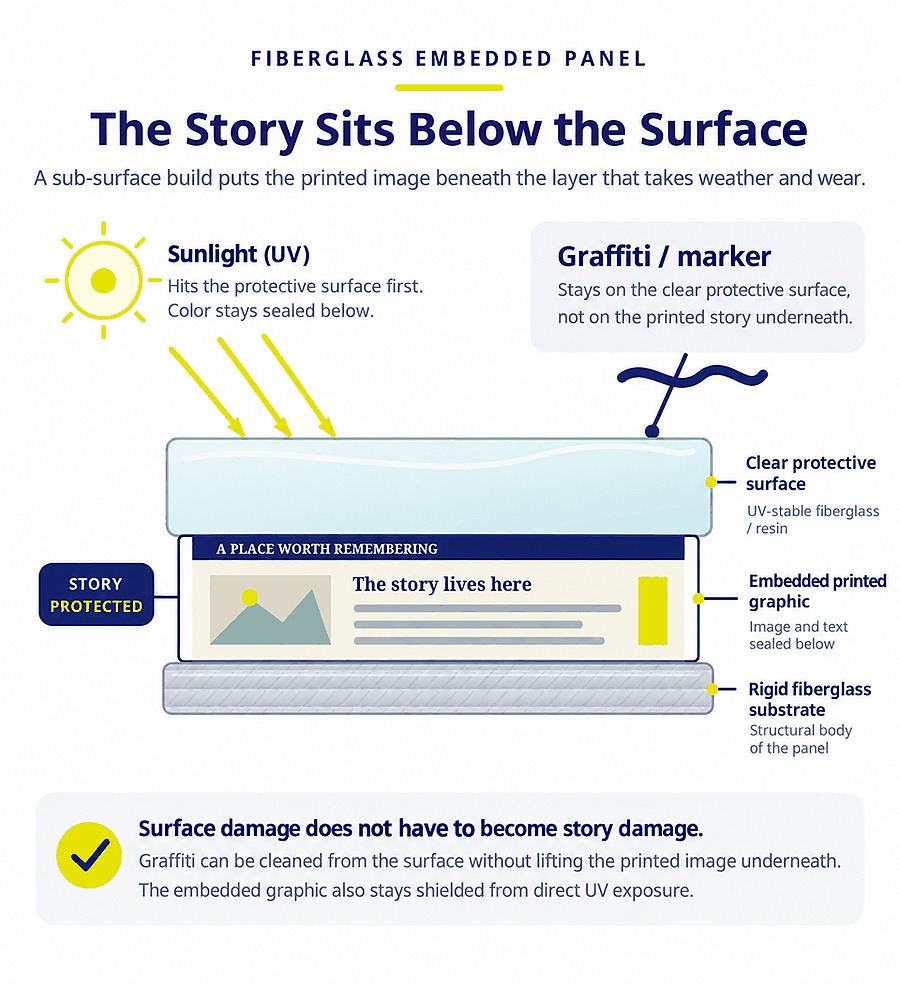 The construction shown above is what separates a sub-surface graphic from artwork printed directly onto an exposed face. With the printed image protected inside the panel, the outer surface takes the wear while the story remains underneath.
For historical markers, that principle leads to several material options Pannier manufactures in-house:
- Fiberglass Embedded (FE) seals full-color graphics within a durable fiberglass panel. It is well suited to markers with photographs, maps, timelines, illustrations, and other detailed content, and is built for a 10-plus year outdoor lifespan.
- Gel Coat Laminate (GCL) offers another durable option for long-term outdoor graphics and may be worth weighing against FE based on the site, budget, and desired finish.
- Weathering steel works especially well when the structure itself is part of the visual statement, including historical, commemorative, and memorial settings.
Cast bronze remains the traditional choice for many historical plaques, and its permanence and appearance can be appropriate for the right project. But it comes with tradeoffs. If a fact needs to be corrected, updating the plaque generally means recasting it. Bronze also has scrap value, which can make plaques a theft target. A graphic panel provides a different kind of permanence: the historical content can be durable without relying on a material that is difficult to replace or revise.
The Plainsboro Centennial timeline shows that approach carrying a substantial amount of history. For the New Jersey township's 100-year anniversary and the reopening of its 1870s Wicoff House Museum, Pannier produced five Fiberglass Embedded panels, each 35 inches by 56 inches, mounted on stainless steel standoffs. The format allowed photographs, dates, text, and other timeline content to remain detailed and readable while using a panel designed for long-term outdoor display.
For a deeper comparison of the available materials and construction methods, see our guides to outdoor sign board material and rigid panels and sub-surface graphics.
Mount and Site the Marker So It Stays Put and Stays Readable
Where and how a marker is installed decides whether it survives weather, mowers, and theft, and whether anyone can comfortably read it. A perfect panel on a poor mount is still a failed marker. A short set of choices covers most of it:
- Pick a base that fits the setting. A low-profile base suits a single approach and keeps sightlines open. A single or double pedestal base raises a panel to a comfortable reading height where people gather. A monument-style mount fits a memorial where the structure is part of the tribute.
- Set the reading height and angle for a standing adult. A marker read from 2 to 3 feet away wants its text centered near eye level and, on a low-profile base, angled up toward the reader.
- Use tamper-resistant fasteners. Security hardware makes a panel far harder to pry off, which matters most for markers in unsupervised public spots.
- Put the footing below the frost line. Posts set in the ground need footers deep enough that seasonal freeze and thaw do not heave them out of level.
- Keep it out of the splash zone. Placement clear of sprinkler spray, mud splash, and snowplow throw protects both legibility and the base.
One point on scope, because it protects your budget and your timeline. Pannier supplies the hardware to attach a panel to its posts or frame, but not ground anchors or installation labor. Site conditions vary too much for one anchoring kit to fit them all, so footing depth and final placement stay with the site owner and the marker is built to that spec. Our guide to outdoor sign installation covers the details that protect that part of the investment.
Chester's Veterans Memorial Park in Pennsylvania is a good example of matching the mount to a public park. Across the 20-acre site, Pannier produced Fiberglass Embedded panels on single and double pedestal bases, raising the content to a comfortable reading height throughout a space built for walking and gathering. The base does quiet work: it puts the story where people can actually stand and read it.
Maintain the Marker So the Story Doesn't Fade
A decades-long lifespan assumes light, occasional upkeep, and the right material is what keeps that upkeep light. A durable marker does not need much, but "not much" is not "nothing." A simple routine keeps a marker readable for its full life: wash the panel a couple of times a year with mild soap and water, remove any graffiti promptly, and check the fasteners and base once a year for anything loosening. Because a sub-surface panel holds its graphics beneath the surface, cleaning and light graffiti removal do not strip the artwork the way scrubbing a surface-printed sign would.
This is where the material choice from earlier pays off. A durable panel turns maintenance into an occasional wipe-down instead of the repainting and refinishing that a lesser sign demands every few years. It also protects the budget over time. A marker that needs professional refinishing every few years quietly costs more across 30 years than a durable panel that needs almost nothing, and the durable panel never spends a season looking neglected while the funding for a touch-up gets sorted out. Name someone responsible for the marker at the dedication, even informally, so the light upkeep actually happens rather than waiting for a problem to force it. Our sign maintenance guide has the full cleaning routine if you want a checklist to hand to whoever cares for the site.
Design and Build the Marker as One Project
The markers that last are the ones where the research, the panel, and the mount were decided together instead of handed between vendors who never spoke. Pannier is a family-owned, in-house manufacturer that handles design, material selection, fabrication, and delivery under one roof, which is what keeps a marker's build consistent from the first proof to the panel that ships. Most clients bring their own finished artwork and Pannier builds it to spec, with design services available when a project needs them.
It helps to be clear about what that partnership does and does not include. Pannier does not research the history for you, does not choose where the marker goes, and does not install it. What it protects is the build itself: the story you approved, manufactured in a material chosen to still carry that story decades from now.
Key Takeaways
- A historical marker sign has two things to protect: the physical marker and the story on it.
- Finish and verify the research before design, because a fact cast or embedded into a panel cannot be quietly fixed.
- Write out the words that date a marker, especially relative time like "recently" and "today."
- Material is the biggest durability lever. Sub-surface graphics resist fade and graffiti, and unlike cast bronze they carry no scrap value for thieves.
- Mount below the frost line with tamper-resistant hardware, and set the panel at a comfortable reading height for the site.
- Light, regular maintenance is the payoff a durable material buys you.
Frequently Asked Questions
What is a historical marker sign?
A historical marker sign is an outdoor panel that records and interprets a person, place, or event of historical significance, built to stand in public and stay readable for decades. Most combine a short, verified narrative with images, and they range from small plaques to full interpretive panels on posts or pedestal bases.
What are historical marker signs made of?
Historical marker signs are made from several durable materials, and the strongest options seal the graphics beneath the surface so they resist fading and vandalism. Pannier manufactures Fiberglass Embedded and Gel Coat Laminate panels, along with weathering steel for a monument look. Cast bronze is the traditional choice but cannot be corrected and is a common target for metal theft.
How long do historical marker signs last?
Historical marker signs last well over a decade when they are built from durable, sub-surface materials and given basic upkeep. Pannier's Fiberglass Embedded panels are built for a 10-plus year lifespan outdoors, and light maintenance extends that further.
How do you keep a historical marker from fading or being vandalized?
You keep a historical marker from fading or being vandalized mainly through material choice. Panels with graphics sealed beneath the surface hold their color against ultraviolet light and let graffiti be cleaned off without lifting the artwork. Tamper-resistant fasteners and thoughtful placement handle the rest.
How much text should go on a historical marker?
A historical marker should carry one clear idea rather than an entire history, because most people read it in seconds, not minutes. Lead with the single most important point, support it with an image, and move any deeper detail to a second panel instead of crowding the first.
Final Thoughts
A historical marker is only as permanent as the weakest decision behind it, whether that is a rushed fact, a fading print, or a mount that heaves out of the ground. Pannier designs and manufactures historical marker signs, interpretive panels, and the frames that hold them, in-house, from design through delivery, in materials built to carry a story for decades. When you are ready to build a marker that protects its story for the long haul, we would like to help.


